
- Cirque du Soleil’s “Crystal” at Fishers Event Center, a photo preview
- The Gatlin Brothers at Brown Country Music Center
- The Black Keys will perform at Innings Festival, Feb 21.
- Gary Clark Jr. will rock the Innings Festival 2025
- Fall Out Boy to appear at Innings Festival in February
- Kris Kristofferson passes away at 88
David Fagin’s Memoir Captures the Music Business Just Before the Internet Changed It
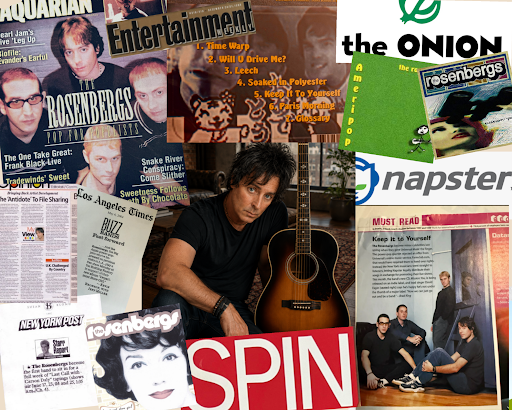
One of the pleasures of Confessions of a Musical Masochist is realizing how often David Fagin and The Rosenbergs arrived at music-business arguments before the industry had developed comfortable language for them. Viral outrage, artist-owned masters, direct digital distribution and file sharing all pass through the memoir at moments when each still felt disruptive or faintly absurd.
The defining episode begins with Farmclub.com, Universal Music’s heavily financed television and label venture. Invited to perform, The Rosenbergs received an agreement Fagin considered extraordinarily restrictive. He responded by writing an email criticizing the terms and sending it to other musicians. The message spread across the industry with the speed of something that would later simply be called viral.
The consequences were immediate. CNN, CNBC, the Los Angeles Times, Entertainment Weekly, Spin and Wired were among the outlets drawn into the story. Universal threatened legal action, then the conflict took a stranger turn as discussion shifted toward potentially signing the band. Courtney Love offered support, and Fagin eventually sat down with Jimmy Iovine to discuss the standoff.
That controversy brought The Rosenbergs to Robert Fripp and David Singleton at Discipline Global Mobile. Their arrangement allowed the band to retain ownership of its masters, years before that issue became a routine part of mainstream artist-rights conversation. Fagin does not romanticize the outcome. The experiment was principled and financially brutal, eventually leaving the band facing a debt of over $200,000 to DGM.

The Napster chapter is equally revealing. While much of the record business treated file sharing as an existential threat, The Rosenbergs partnered directly with the service. Napster sponsored a tour, featured the band on its homepage and helped create a two-disc edition of Mission: You with a second copy specifically intended to be shared. Thousands of people joined the mailing list.
Then came the Fagin twist. Many of those newly acquired fans were too young to enter the clubs the band had booked, producing what The Rosenbergs jokingly called the No Fans Allowed Tour. The anecdote summarizes the memoir’s recurring relationship with innovation: the band could identify the future and still find a way to lose money inside it.
Confessions of a Musical Masochist is valuable beyond its celebrity encounters and comic disasters. It preserves a musician’s-eye view of the moment when the internet destabilized assumptions about ownership, promotion and distribution. Fagin’s story is funny, but its underlying history is serious. Being early, the book repeatedly demonstrates, is very different from being rewarded.
Related Posts


Latest Backstories
-
 Judy Collins Enchants at Brown County Music Center: A Night to Remember, March 22, 2025
The air was thick with anticipation on March 22,...
- March 28, 2025
-
 The story behind “Diamonds and Rust”, a song by Joan Baez, about Bob Dylan
The story behind the song “Diamonds and Rust” is...
- April 1, 2024
-
 Backstory: Bob Seger’s “Shame on the Moon”
Bob Seger’s 1982 hit “Shame on the Moon” was...
- December 18, 2023
-
 The Real Story behind the song, “Mr. Bojangles”
In our continuing weekly series, we examine the backstory...
- September 6, 2023
-
 RIP Robbie Robertson.
Canadian, Robbie Robertson, legendary lead guitarist of “The Band”...
- August 9, 2023
-
 Celebrate Good Times: The Story Behind Kool and the Gang’s Hit Song
If you have ever been to a wedding, a...
- July 12, 2023
Latest Photo Galleries
-
 Styx in Noblesville Indiana, the Windy Cities Tour
Styx brought their signature blend of progressive rock anthems,...
- August 12, 2026
-
 Jack Johnson Delivers Warm Vibes and Surprise Collaborations at Ruoff Music Center
On a stormy July 4 evening at Ruoff Music...
- July 6, 2026
-
 Post Malone Brings Big Energy to Lucas Oil Stadium on the Big Ass Stadium Tour
Post Malone has carved out a special place in...
- June 15, 2026
-
 Kenny Wayne Shepherd Band Honors 30 Years of Ledbetter Heights at Brown County Music Center
The Kenny Wayne Shepherd Band rolled into the Brown...
- May 7, 2026
-
 The Black Keys: Gritty Blues-Rock Gold at Louisville Palace
The Black Keys have a way of making a...
- May 5, 2026
0 comments